
The Tax menu
Below Processing, the Tax group has three pages, without numbers: Monthly returns, Tax instalments and Corporate / personal income tax return. They are read, not entered: everything comes from the Processing steps. They feed the cash flow table, which pays each return on its due date.
Monthly returns
The page has two tables, one month per column and a total per year. A selector, at the top, chooses the year.
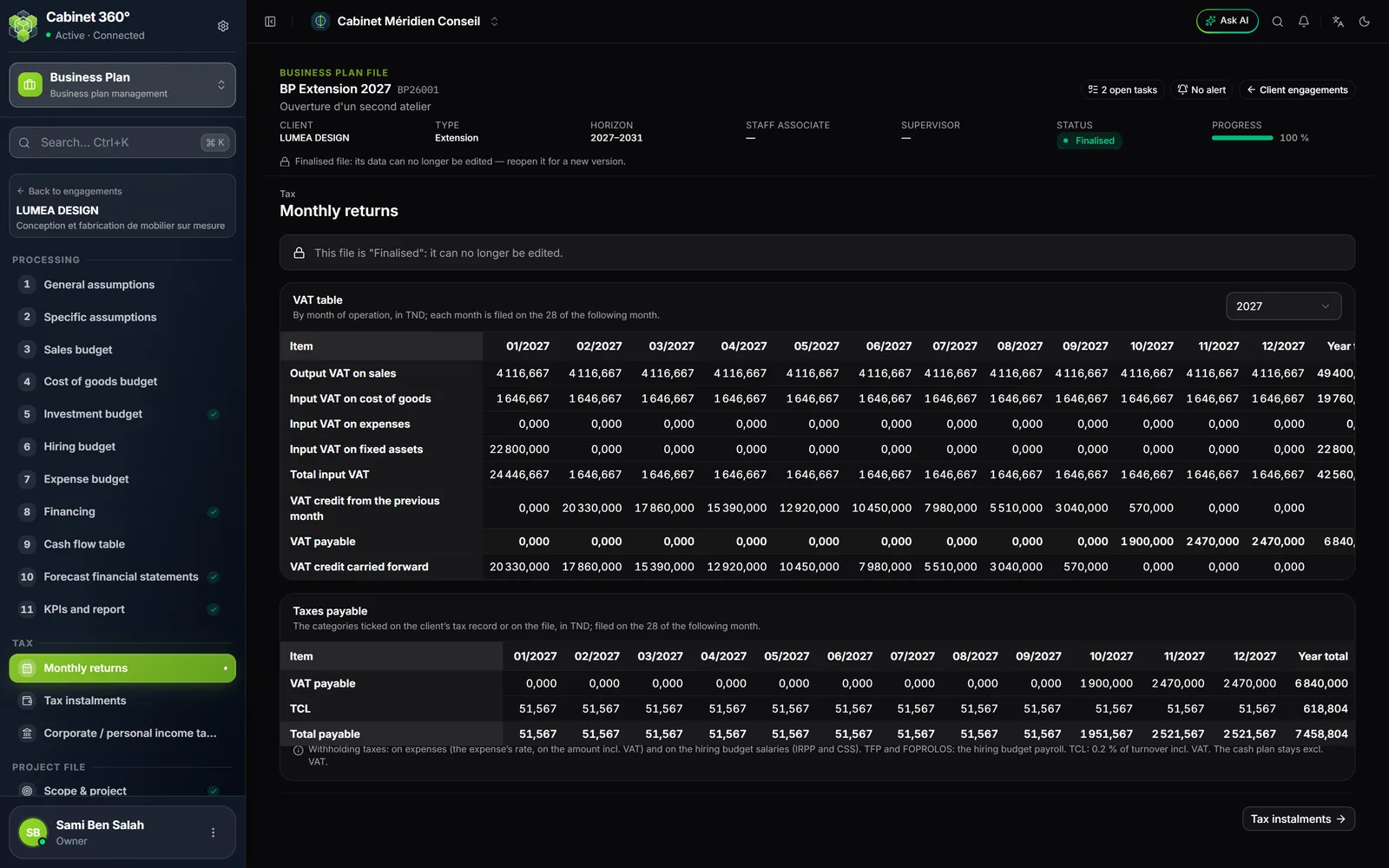
The VAT table
By month of operation, each month being filed on the 28th of the following month for a legal entity, on the 15th for an individual.
| Line | Where it comes from |
|---|---|
| Output VAT on sales | The rate of each sales line, on sales net of reductions and discounts |
| Input VAT on cost of goods | The cost of each sales line, at the line's purchase rate, in the months of the sales |
| Input VAT on expenses | The rate of each expense, on its due dates |
| Input VAT on fixed assets | The rate of each investment, in the month of acquisition |
| Total input VAT | The sum of the three |
| VAT credit from the previous month | The credit carried forward |
| VAT payable or VAT credit carried forward | The month's balance |
The taxes payable
The second table gives, for the taxes and duties ticked in step 2 (when it is created, the engagement takes over those of the client's tax record), what is paid each month. If nothing is ticked, it gives the taxes the plan can compute and that have an amount:
- Withholding taxes: those on expenses (at the expense's rate, on the amount incl. VAT) and those on the hiring budget salaries (IRPP and CSS);
- VAT payable: always present, just below the withholding taxes, taken from the VAT table;
- TFP and FOPROLOS: the hiring budget payroll;
- TCL: 0,2 % of revenue incl. VAT, sales net of discounts;
- Total payable.
A ticked tax that the business plan cannot compute reads “Not computed by the business plan”, with no amount.
Tax instalments
Three instalments of 30 % of the previous year's tax, paid in June, September and December: on the 28th for a legal entity, on the 25th for an individual. For each year: the Reference tax, Instalment 1, Instalment 2, Instalment 3 and the Total paid.
The instalments are paid in the cash flow table of their year and are deducted from the tax due. There are none in the first year, for lack of a reference tax, nor for a client that is not liable to income tax.
Corporate or personal income tax return
The page takes the name of the client's tax: Corporate income tax return for a legal entity, Personal income tax return (IRPP) for an individual. For an association, it says that no income tax return is due.
| Line | What it gives |
|---|---|
| Profit before tax | Taken from the income statement |
| Losses still carried forward | The losses that can still be carried forward after the year, the year's loss included |
| Taxable profit | After carrying losses forward |
| Minimum tax | The minimum due even without profit |
| Corporate tax due or IRPP due | At the assumptions' rate (corporate tax) or on the progressive scale (IRPP) |
| Social solidarity contribution (CSS) | At the assumptions' rate, or the individuals' rate |
| Total tax | The tax and the CSS |
| Instalments paid in the year | Taken from the instalments page |
| Balance payable and Balance due date | 25/03 of the following year for corporate tax, 25/04 for IRPP |
A year's balance is paid the following year: the cash flow table shows it as Corporate tax balance for the previous year (or Income tax balance for the previous year for IRPP).