
The page
Step 8 has three parts: the Initial financing plan, Financing and Debt service.
The initial financing plan
The plan sets the start-up needs against the resources that cover them. As uses, it only counts the investments of nature “Initial investment”, and as sources, only the financing put in place in A1 at the latest.
| Uses | Sources |
|---|---|
| Investments (initial) | Each new financing put in place at the start, by type |
| Working capital requirement | |
| Total uses | Total sources |
The box says Balanced plan when the sources cover the uses, within a tolerance (for example 1,000 TND). Otherwise, Unbalanced plan says what is missing (“… of sources is missing to cover the uses”) or what is in excess.
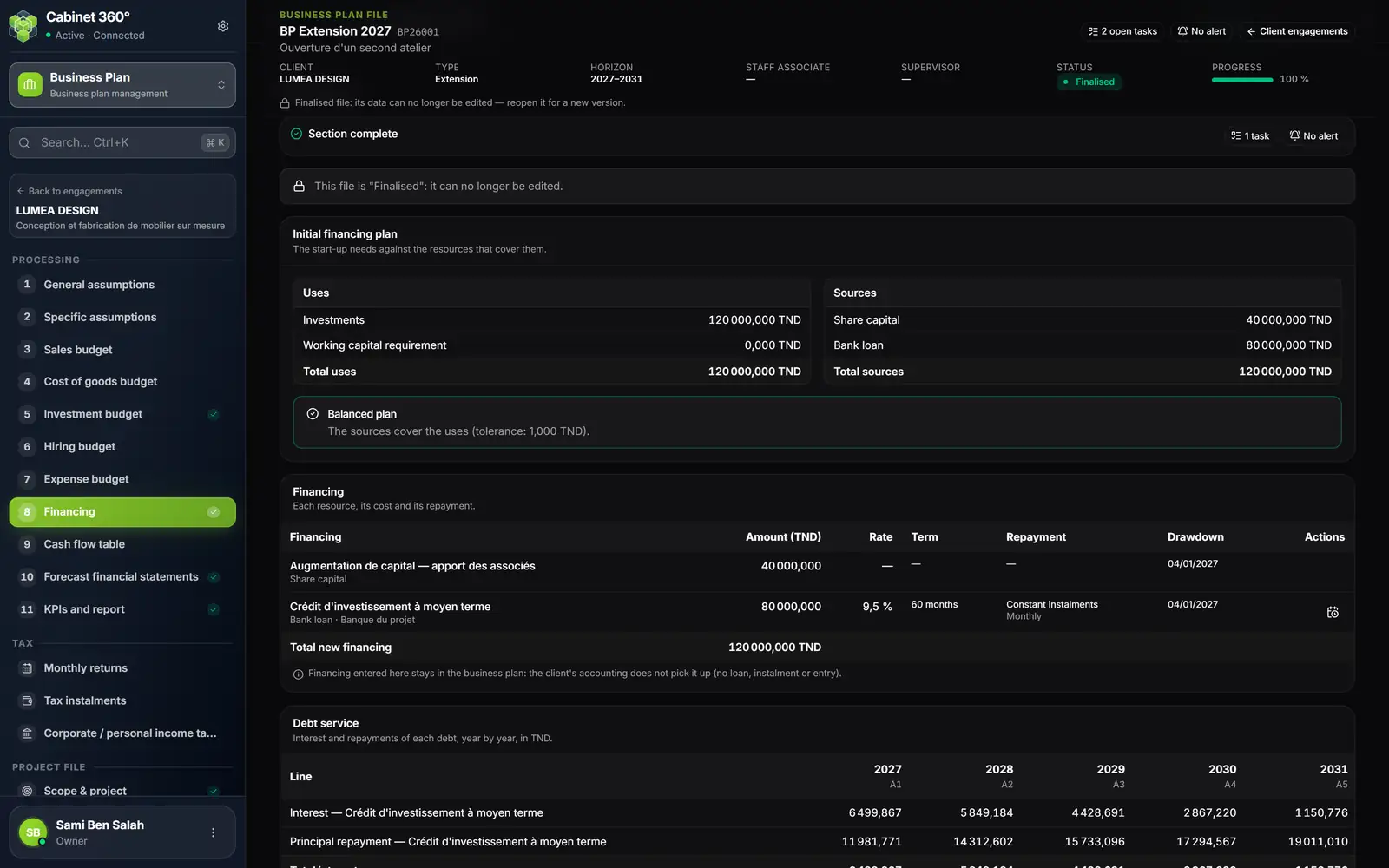
- 1. Section complete: the financing plan is balanced.
- 2. Uses: the initial investments and the start-up working capital requirement.
- 3. Sources: capital, loans, grants, contributions put in place at the start.
- 4. The verdict: “Balanced plan” or “Unbalanced plan”, with the gap and the tolerance.
- 5. Financing: amount, rate, term, repayment, drawdown.
- 6. The schedule of a loan, instalment by instalment.
- 7. Debt service: interest and principal repaid, year by year.
Add a financing
- Click Add a financing. The New financing window opens.
- Choose the Financing type: Share capital, Shareholder current account, Bank loan, Leasing, Grant or Other financing.
- Enter the Label (for example “Investment loan”), the Lender and the Amount.
- Choose the Drawdown date. Empty: the project start.
- For a loan or a lease, fill in the Repayment block: Annual rate (%), Term (months), Grace period (months), Frequency and Repayment method.
- Click Save.
| Field | What you need to know |
|---|---|
| Term (months) | The total term, grace period included: 84 months, 24 of them grace. |
| Grace period (months) | During the grace period, only interest is paid. |
| Repayment method | Constant instalments, Constant principal or Bullet (in fine). |
| Debt existing at start | A debt already on the balance sheet at the start: its amount is the outstanding balance, and it does not enter the sources of the initial plan. Share capital and grants are never existing debts. |
| Grant release (years) | The pace at which a grant is released to income. Empty: the average depreciation period of the assets it finances, failing that 5 years. |
| Empty term | When the block says Repayment (optional): a permanent resource, without a schedule; its interest runs each year at the rate entered. |
The Financing table ends with the Total new financing. Existing debts are given below it, outside the total.
A loan's schedule
A line's schedule icon opens Repayment schedule — …, computed from the drawdown date.
- By year: Interest, Principal, Instalments and Outstanding at year end.
- The detail of each instalment (“Details of the 60 instalments”): number, date, interest, principal, instalment and outstanding balance.
- The rate of a period is proportional (annual rate × months ÷ 12); the last instalment settles the principal.
Year-end closing
Under the schedule, Year-end closing applies the rules of the accounting's year-end work:
| At 31/12 of each year | What it gives |
|---|---|
| Interest paid | The interest paid in the year |
| Accrued interest at 31/12 | Interest earned but not yet due |
| Interest expense for the year | The share of each instalment attached to the year, prorated by days |
| Loan due after one year | The principal still to repay beyond twelve months |
| Due within one year | The principal repaid in the twelve months after 31/12 |
These figures go to the financial statements: the interest expense to the income statement, the interest paid to cash, the part due within one year and the accrued interest to the balance sheet.
Debt service
The last table gives, for each debt and each year: Interest — …, Principal repayment — …, then Total interest, Total repayments and Principal outstanding at year end.