
A register you read, not enter
"The movements of the company's share capital, from incorporation to today: subscriptions, share transfers, capital increases and reductions. The register is read from adopted articles of association and validated transfers; nothing is entered here."
The register reads two kinds of documents:
- the adopted articles (validated, registered or archived), as frozen at their validation;
- the validated or registered share transfers.
It compares them with today's client record. Nothing is typed here: to change the register, you validate articles or a transfer.
Choosing a company
Choose the Company in the list ("Search for a company…"). Only companies (legal entity type) are offered: an association does not appear. Four figures show: Share capital (record), Nominal value, Number of shares and Shareholders.
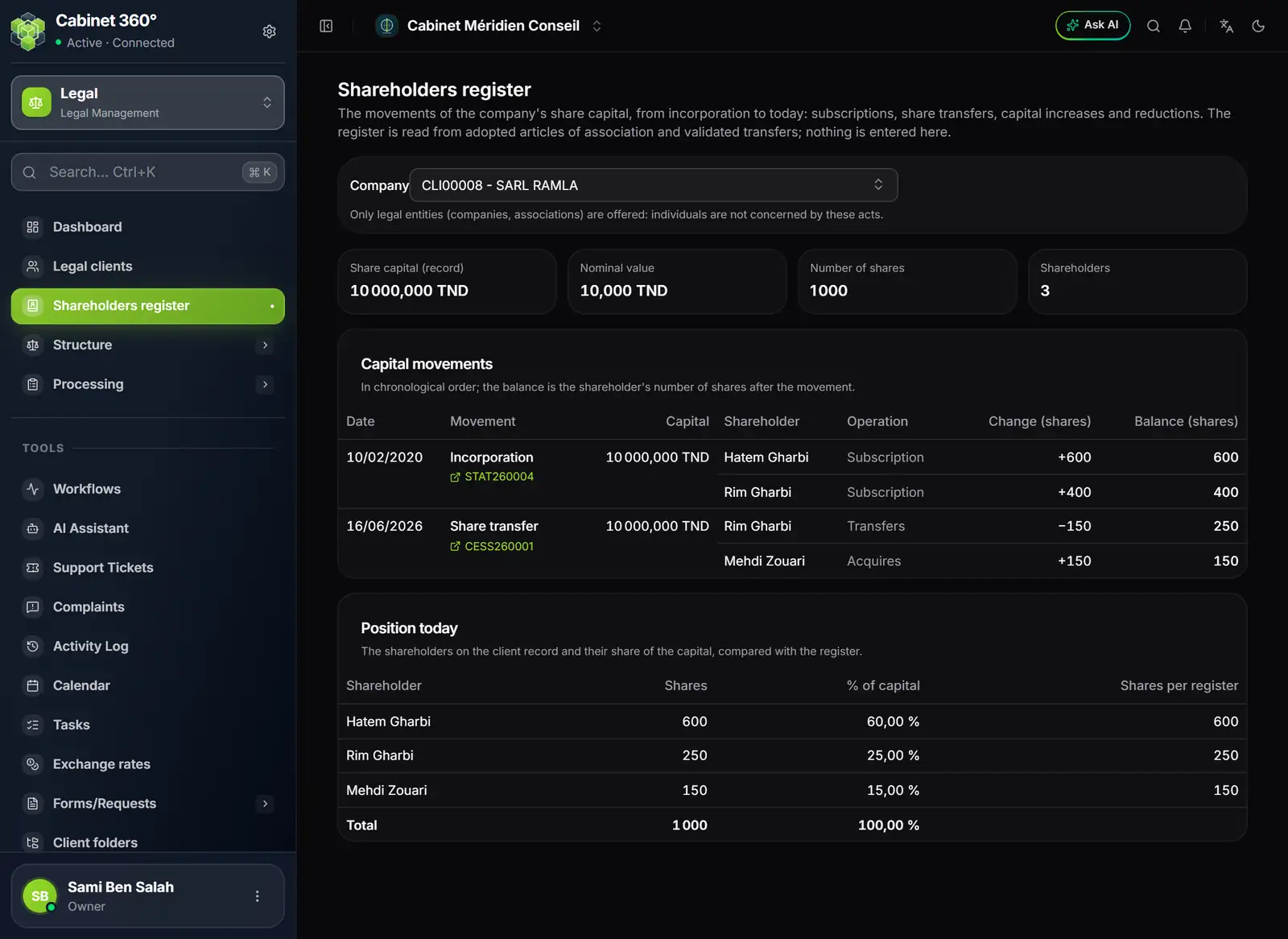
- 1. Company: choosing the company.
- 2. Four figures read from the client record.
- 3. Incorporation: each shareholder subscribes their shares, link to articles STAT260004.
- 4. Share transfer: the transferor loses 150 shares, the acquirer gains them.
- 5. Balance (shares): what the shareholder holds after the movement.
- 6. Position today: the client record, compared with the register.
The capital movements
"In chronological order; the balance is the shareholder's number of shares after the movement." Each movement has its date, its nature, the capital after it and a link to the document behind it. Then one line per shareholder concerned: the operation, the change and the balance.
| Movement | Where it comes from | Operations |
|---|---|---|
| Incorporation | the first adopted articles of incorporation | Subscription |
| Share transfer | a validated or registered transfer | Transfers, Acquires |
| Capital increase | amended articles with a higher capital | Subscription |
| Capital reduction | amended articles with a lower capital | Reduction |
| Articles updated | amended articles, same capital, different split | Unexplained difference, "To check" |
| (first known split) | the first amended articles, with no adopted articles of incorporation | Known allocation |
Amended articles that touch neither the capital nor its split (a transfer of the registered office, for example) do not appear. On the same date, the incorporation comes first, then transfers, then amended articles.
Without validated articles of incorporation
The register guesses nothing. If no articles have been adopted, the split at incorporation is deduced from today's record, each transfer undone in reverse, and the screen says so: the capital at incorporation is unknown. If only amended articles have been adopted, the register starts from the first ones ("Known allocation"), and earlier movements have no balance.
The position today
"The shareholders on the client record and their share of the capital, compared with the register." For each shareholder: their Shares, their % of capital (two decimals) and the Shares per register. A Total line closes the table.
When the record and the register disagree, a box "The register does not match the client record" names each gap: the shareholder, their shares on the record, and their shares according to the register. Three usual causes:
- the client record was corrected by hand;
- a transfer was validated before shareholders were updated automatically (the line reads "Shareholders not updated by the validation");
- the capital changed without amended articles.
Correct the client record, or complete the missing documents.