
Opening the summary
The summary is the last entry in the menu of each file, in the same place in all three. There is one per engagement. It brings together the files opened on that engagement: a file counts as opened from the first time it is opened (chapter 3).
The top bar shows the client, the engagement, the Valeur retenue (Retained value) and a badge: En cours (In progress), or Conclue le … (Concluded on …).
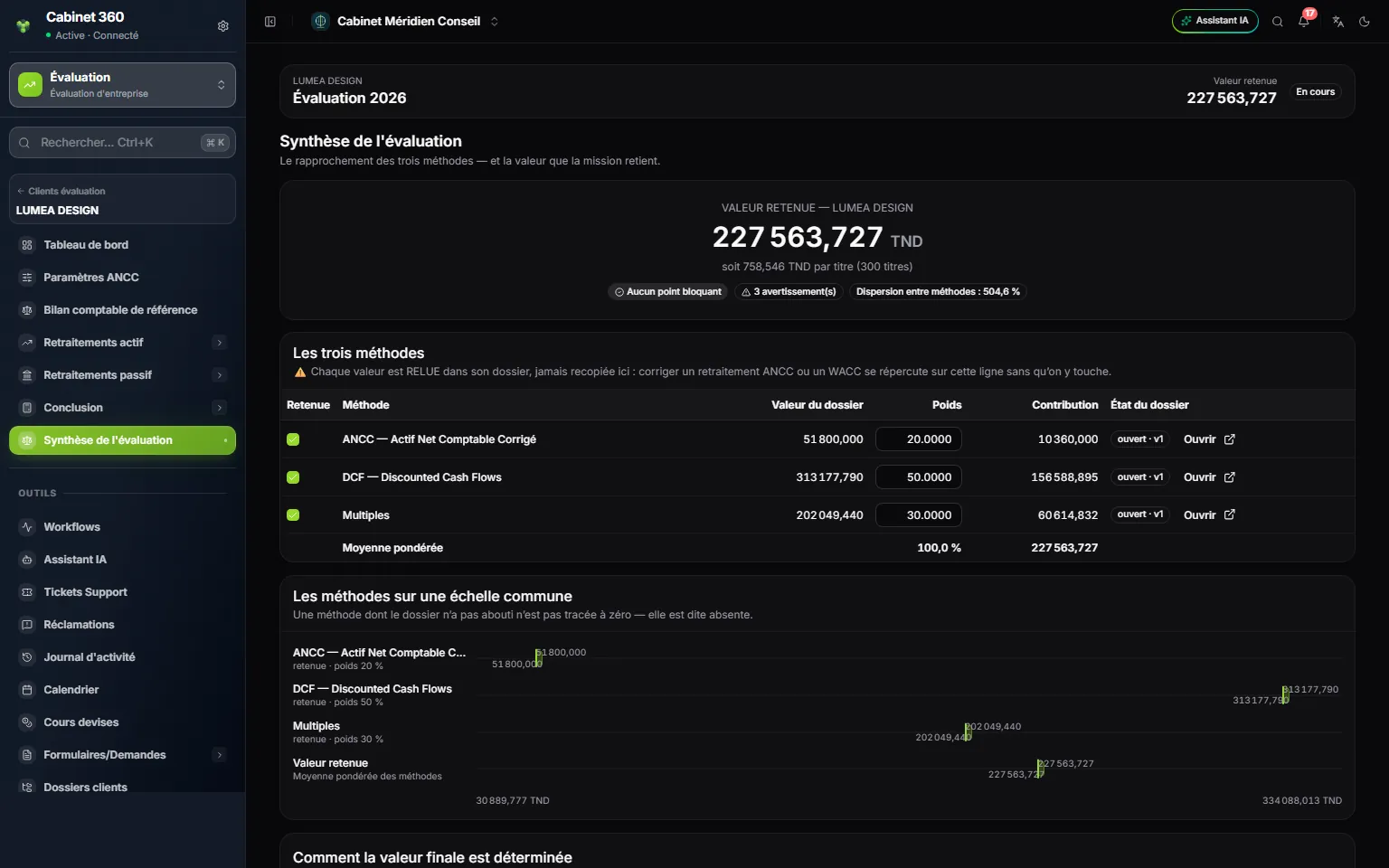
- 1. The retained value, and the value per share.
- 2. The badges: blocking points, warnings, spread between methods.
- 3. Retenue (Retained): tick the methods that count.
- 4. Valeur du dossier (File value), read again every time the page opens.
- 5. Poids (Weight): it is saved when you leave the box.
- 6. État du dossier (File status) and Ouvrir (Open), which leads to the file.
- 7. Les méthodes sur une échelle commune (The methods on a common scale), and the retained value.
The three methods
The Les trois méthodes (The three methods) table gives, for each method:
| Column | What it says |
|---|---|
| Retenue | The method counts in the final value |
| Méthode (Method) | ANCC, DCF or Multiples |
| Valeur du dossier | The value the file publishes, read again every time the page opens |
| Poids | Its share of the average, in points |
| Contribution | Value × weight ÷ 100 |
| État du dossier | « ouvert » (open) or « verrouillé » (locked), its version, and the Ouvrir link |
Each file comes in through the value it publishes:
- ANCC: the retained value, after premiums and discounts, not the gross net assets;
- DCF: the Equity Value of the base case, never of another scenario;
- Multiples: the weighted Equity Value of the retained multiples.
A method without a file on the engagement says so: « Aucun dossier … sur cette mission — il s'ouvre en réglant la méthode de la mission, puis ses paramètres. » (No … file on this engagement — it opens once you set the engagement's method, then its settings.) Its Retenue box and its weight are greyed out.
Retained but left out of the average
A retained method whose file gives no value, or whose weight is zero, carries the mention « retenue mais hors moyenne — sans valeur ou sans poids » (retained but left out of the average — no value or no weight). It enters neither the total of the weights nor the average, and the checks « Chaque méthode retenue rend une valeur » (Each retained method gives a value) and « Les pondérations totalisent 100 % » (The weights add up to 100%) prevent concluding.
The weights
The Moyenne pondérée (Weighted average) line totals the weights and the average. Weights are never brought to 100% automatically: a total of 90% means a method is missing, and the page says so.
The Les méthodes sur une échelle commune chart places each value and the retained value on the same axis. A method whose file has not reached a value is not plotted at zero: it is shown as missing.
How the final value is set
Choose the Approche (Approach):
| Approach | Final value | What it requires |
|---|---|---|
| Moyenne pondérée des méthodes (Weighted average of the methods) | The average of the retained methods, according to their weights | Weights that add up to 100% |
| Une seule méthode (A single method) | The value of one file; the others cross-check | Méthode retenue (Selected method) |
| Fourchette de valeurs (Range of values) | The midpoint of the range; both ends stay on screen | Borne basse (Low end) and Borne haute (High end) |
| Valeur retenue à dire d'expert (Value set by expert judgement) | The value you enter | Valeur retenue |
The value per share divides the final value by the number of shares in the ANCC settings, failing that the DCF's, failing that the multiples'; without a number of shares, it is not computed.
Justifying
Three texts, saved when you leave the field (« Synthèse enregistrée », Summary saved):
- Justification de la valeur retenue (Justification of the retained value): mandatory. « Why this value, and not the average of the three » is the first question anyone asks of a summary.
- Conclusion de la mission (Conclusion of the engagement): the text the report will take up.
- Réserves (Reservations): what the valuation does not cover, and the assumptions it rests on.
The summary checks
| Check | Type |
|---|---|
| Au moins un dossier de méthode est ouvert (At least one method file is open) | Blocking |
| Au moins une méthode est retenue (At least one method is retained) | Blocking |
| Chaque méthode retenue rend une valeur (Each retained method gives a value) | Blocking |
| Les pondérations totalisent 100 % (The weights add up to 100%; weighted approach) | Blocking |
| L'approche retenue est complètement renseignée (The chosen approach is fully filled in) | Blocking |
| Une valeur finale est déterminée (A final value is set) | Blocking |
| La valeur retenue est justifiée (The retained value is justified) | Blocking |
| Les dossiers des méthodes retenues sont verrouillés (The files of the retained methods are locked) | Warning |
| La dispersion entre méthodes reste explicable (The spread between methods stays explainable; above 50%) | Warning |
| La conclusion de la mission est rédigée (The engagement's conclusion is written) | Warning |
Each check carries its verdict (OK, Bloquant, Blocking, or À voir, To check) and, if it fails, what is found. A spread above 50% does not block: it says something about the assumptions, not about the calculation.
Concluding the valuation
- Clear the blocking checks: the Conclure l'évaluation (Conclude the valuation) card names them above the button.
- Click Conclure l'évaluation. The server runs the checks again.
- « Évaluation conclue » (Valuation concluded): the badge becomes Conclue le …, the card names who concluded, and the whole page freezes.
Concluding belongs to the engagement manager or the firm's management. A team member who tries gets a refusal that names the engagement manager.
Reopening the summary
Enter the Motif de la réouverture (Reason for reopening), mandatory, then click Rouvrir la synthèse (Reopen the summary). The reason is added to the Réserves (« Réouverture : … », Reopening: …): it is the trace that will explain why the engagement changed its conclusion. Reopening also belongs to the engagement manager or the firm's management.
And the report?
The valuation summary does not print by itself. At the bottom of the page, one Rapport … (Report …) button per opened file leads to each method's valuation report (chapter 12); a report only shows when the engagement carries its method.